Dave Helfrich Stories: High Cascades Boys Camp
In 1947, Prince Helfrich started the High Cascades Boys Camp with just four paying boys and a simple idea: teach young men how to be capable in the outdoors. What began as a small mountain pack camp grew into two-week wilderness sessions that ran into the early 1970s, eventually expanding to include both horse camps in the high country and boating camps on the river.
Boys learned to fly cast properly, pack horses, tend a fire, row in current, and respect the power of wild places. Promotion was modest — a seminar at Meier & Frank in Portland and strong word of mouth — but the program grew steadily, shaping generations of boys, some of whom later returned to work in the Helfrich river business.
What follows is a firsthand look at how those camps operated — and the values behind them, in the words of Dave Helfrich, from his book Around the Campfire. Purchase the book Here
Boys camp is something my dad started back in 1947, and we ran those camps into the early ‘70s. Some were horse camps, and some were boating camps. I think the first camp we put together we had about four payin’ boys. I still hear from some of ‘em.
I was fifteen years old at the time. At that age I was a good packer. I could handle horses. Dad worked through Jack Meier of Meier and Frank in Portland. Jack was a good friend and customer. He made lots of river trips with us over the years.
Jack Meier put up a display on one of his floors up there in Portland. He would have a tent, the kind we were using, and all that stuff set up. He had a good display of sleeping bags, and fly fishing outfits. He invited Dad to do a seminar about once a year. He publicized the event, so people knew that Prince Helfrich was going to be at Meier and Frank to talk about the Skyline Summit Camp, and to see the camping display.
And then there was a Doctor Goldsmith. Although Dr. Goldsmith had two girls, he was completely in favor of teaching boys how to do things. He was a real supporter of Prince’s Boys’ Camp, and he spread the word about the camp to his patients. He told folks how we taught boys how to assemble a rod. We’re talking about fly fishing. We’re not talkin’ about a bunch of spinnin’ and worm outfits. We were showin’ the boys how to attach the reel correctly, how to string the line up through the guides, how to tie on a leader on, how to tie the fly to the leader, and then how to fish. Dr. Goldsmith was a good promoter.
Early on, many of those kids went back and told their friends. We weren’t doing very much advertising, just that little annual Meier and Frank thing, old Doc Goldsmith, and word-of-mouth by the campers. We also printed a little brochure and sent it out to people.
The program grew to where we had as many as twenty-five at a time. In fact, I think we limited it to twenty-five. We had two two-week sessions. In addition to fishing, we taught good camping manners, how to conduct yourself out in the wilderness, how to build and tend a fire. Starting a fire wasn’t a problem. In August, it was pretty dry up there in that country, so we taught them how to tend it. We packed into the high mountains, and this necessitated using the horses we used for elk and deer hunting, and for other pack trips in the mountains. I took several pack trips in the mountains after I graduated from high school. We had this pack string and we’d been using them back in the Boy’s Camp, and they were broke in. Man, every horse knew where his place was. They were well behaved.
We also did some hatchet work. Can you imagine a camper being allowed to do that today? I also took my two good target rifles. We had a 50-foot range out there. I’d put these targets up for the kids to shoot at. We’d give a prize to the kid who had the best group. They didn’t have to hit in dead center. I judged them based on the best three shot group, and that was fairly easy to figure out who won.
We set up horseshoes and other kinds of games for the kids to mess around with. We kept them busy. We’d take ‘em on hikes. They’d get a little restless, and so we’d say, okay fellas let’s go up here a ways. We’d take off and head there above the trail and go across country, then circle around and come back. Boy, you wouldn’t dare do that nowadays.
We taught the boys how to take good care of the wilderness, and how to fish and fly cast. And we had practice in taking hooks out. Every once in a while one of the kids would hook himself. We later took the barbs off so if someone hooked themselves, or hooked one of the other kids, the fly would be easier to remove. The hook could be easily retrieved with a pair of needle-nose pliers.
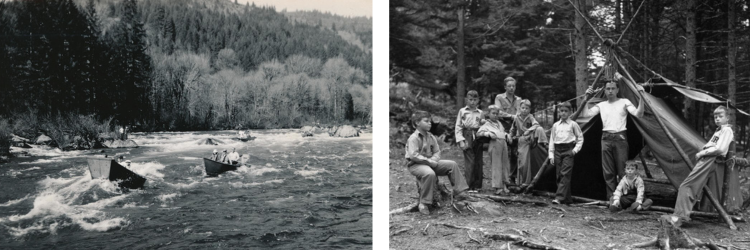
We had a boating camp too. That camp evolved with a few of the older kids. They had been going to the mountain camp where we packed in, and they were getting restless to do something else. So my dad hatched the idea of taking them down the river in boats. He had a whole fleet of those little plywood boats that he built. Double-enders. He taught these kids how to row. Later, some of these kids came to work for us in the business.
So we developed the River Camp. We’d teach those kids how to row, and how to follow one another, and how to follow a good lead boat down the river. If someone had a hard time keeping up, the lead boat would have to slow down a little bit. We’d teach these kids how to row in a current. They’d row across the river, touch the bank and come back. They’d find out quick there’s a current out there, and we’d sure find out if they could row or not, and adapt to that current. We always worried that the boys might be too casual about the river and the rapids. It’s much better to be a bit anxious about the river, than to be too casual.
And then we had a Fall Boys Camp up on Smith River. We didn’t have to use the horses there. We could just hike in and take everything we needed. And that was for boys about eight to ten. If they were 11 or older, they could come to the River Camp.